
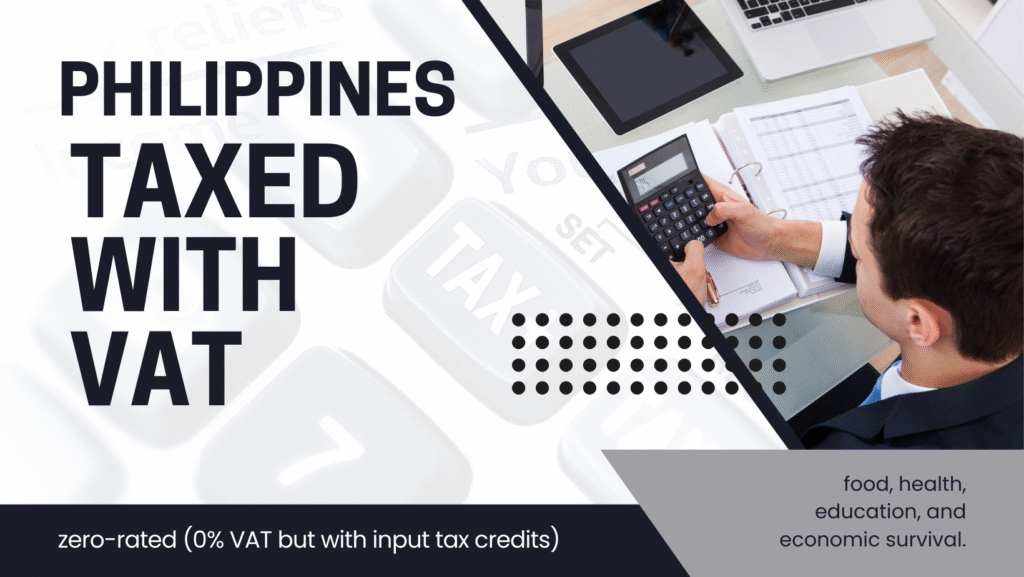
As Filipinos continue to feel the pressure of rising prices, conversations about VAT (Value-Added Tax) are trending again — especially with news about proposed VAT-cut bills. But before debating new laws, one important question must be answered:
👉 What is already VAT-exempt or zero-rated under Philippine law today?
Contrary to what many believe, not everything is subject to VAT. In fact, the Philippine government already exempts several essential goods and services — and gives special treatment to exports and foreign-client services.
Let’s break it down clearly.
Understanding VAT in Simple Terms
VAT in the Philippines is currently 12%, imposed on most goods and services.
However, the law recognizes that taxing basic needs can worsen poverty and inflation. That is why the National Internal Revenue Code (NIRC) provides two special categories:
- VAT-Exempt transactions – no VAT charged and no input tax credit
- Zero-Rated transactions – 0% VAT but input tax credits are allowed
These two are often confused, but they serve different economic purposes.
VAT-Exempt Goods: Protecting Basic Needs
Under Philippine tax law, the following are VAT-exempt when sold in their original state:
- Rice
- Fish and seafood
- Fresh meat and poultry
- Fruits and vegetables
- Other unprocessed agricultural and marine food products
This means these items are not supposed to carry VAT at all when sold fresh and unprocessed.
Why?
Because taxing raw food directly impacts the poor and middle class. This exemption is meant to help stabilize food prices and protect household consumption.
Trending idea:
Food security is also tax policy.
#FoodSecurity #BasicNeeds #VATExempt
VAT-Exempt Services: Health, Water, and Education
Certain essential services are also protected from VAT:
1. Public Education Services
Educational services provided by:
- Government schools
- Properly accredited private schools
are VAT-exempt.
The logic is simple: education is a public investment, not just a business transaction.
2. Basic Medical Services
Many medical services and selected medicines are VAT-exempt under BIR and DOH rules. This helps reduce the cost of healthcare, especially for ordinary Filipinos.
3. Water Supplied by Water Districts
Historically and legally, water utilities operated by public water districts have been treated as VAT-exempt.
This is based on the principle that water is a basic human necessity, not a luxury.
#PublicService #HealthCare #EducationForAll #WaterIsLife
Zero-Rated Transactions: Helping Exports and Freelancers
Not all tax relief means exemption. Some transactions are zero-rated, which means:
✔ VAT rate = 0%
✔ Input VAT can still be refunded or credited
These include:
Export Sales
Goods sold abroad by VAT-registered businesses are zero-rated. This makes Philippine exports more competitive globally.
Services to Foreign Clients
Certain services rendered to foreign clients and paid in foreign currency (such as outsourcing, IT services, and freelancing) may qualify as zero-rated.
This is crucial in today’s digital economy where many Filipinos work remotely for overseas companies.
#ExportEconomy #DigitalJobs #FreelancePH #ZeroRatedVAT
Why This Matters Now
With inflation still affecting food, transport, and utilities, lawmakers are proposing VAT-cut bills. But even without new laws, Filipinos should already know:
✅ Many essential goods are already VAT-free
✅ Key services are protected
✅ Export and foreign-client services are supported
The real challenge is not just the tax rate — but:
- Proper implementation
- Price transparency
- Enforcement against abusive pricing
Tax relief means nothing if businesses do not pass savings to consumers.
#InflationPH #TaxJustice #EconomicRelief
VAT Policy Is Social Policy
VAT is not just a revenue tool. It is also:
- A poverty issue
- A health issue
- A food issue
- A digital economy issue
When VAT exemptions cover food, water, health, and education, they protect dignity.
When zero-rating supports exports and freelancers, it strengthens national income.
Understanding this helps Filipinos:
- Make better financial decisions
- Hold policymakers accountable
- Spot misinformation online
Final Thoughts
The Philippines already has built-in VAT protections for:
- Food in its original state
- Public education
- Basic medical services
- Water districts
- Export sales
- Services to foreign clients
As debates over VAT cuts continue, citizens must ask:
👉 Will new laws strengthen these protections — or weaken government services due to lost revenue?
Tax reform should not be emotional. It should be evidence-based and people-centered.
Because in the end, VAT policy is not about numbers —
it is about survival, fairness, and economic balance.
#VATPhilippines #TaxReformPH #ConsumerRights #DigitalEconomyPH #FoodAndHealth #EconomicPolicy #PHLaw #FinancePH